
Background
ivmodel::card.data is one of the standard teaching
datasets for instrumental variables. It studies returns to schooling
using college proximity as an instrument for education.
Objective
The goal is to move from a single IV estimate to a subgroup-specific local IV effect. The question becomes:
where is log wage, is years of education, is college proximity, and contains observed background variables.
Analysis setup
dat <- prepare_case_card_data()

fit <- fit_instrumental_forest(
  data = dat,
  outcome = "outcome",
  treatment = "treatment",
  instrument = "instrument",
  covariates = setdiff(names(dat), c("sample_id", "outcome", "treatment", "instrument")),
  sample_id = "sample_id",
  seed = 123,
  num_trees = 400,
  tree_minbucket = 160
)
#> Warning in get_scores.instrumental_forest(forest, subset = subset,
#> debiasing.weights = debiasing.weights, : The instrument appears to be weak,
#> with some compliance scores as low as -0.359

fit$check_table
#>                 check_name        value status
#> 1                rows_used 2220.0000000   info
#> 2     rows_dropped_missing    0.0000000     ok
#> 3               outcome_sd    0.4396932     ok
#> 4             treatment_sd    2.5877066     ok
#> 5            instrument_sd    0.4631137     ok
#> 6 cor_treatment_instrument    0.1258198     ok
#> 7            first_stage_f   35.6771160     ok
fit$subgroup_table
#>   subgroup                                     rule   n effect_mean
#> 1       G1 exper>=5.5 & fatheduc< 8.5 & exper< 11.5 499    1.110766
#> 2       G3  exper>=5.5 & fatheduc>=8.5 & exper>=8.5 226    0.536643
#> 3       G4  exper>=5.5 & fatheduc>=8.5 & exper< 8.5 306    3.070764
#> 4       G6                  exper< 5.5 & exper>=3.5 479   -2.255946
#>     effect_low effect_high
#> 1 -0.105598562    2.327130
#> 2  0.343413025    0.729873
#> 3  0.004119645    6.137409
#> 4 -6.592747148    2.080855
Design view
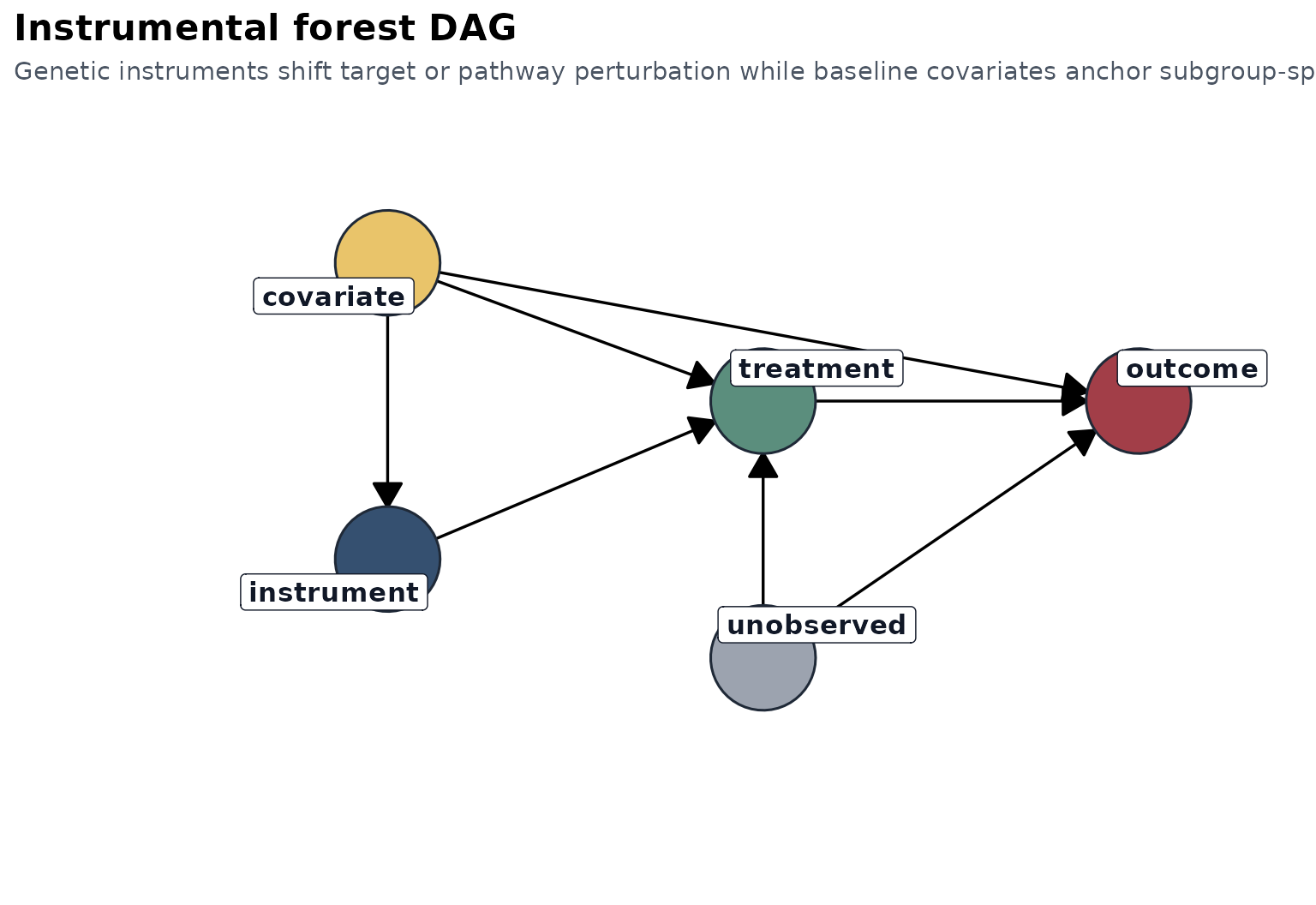
The DAG emphasizes why IV is needed: unmeasured determinants of schooling and wages can bias a naive observational effect of education.
First stage
plot_first_stage(fit)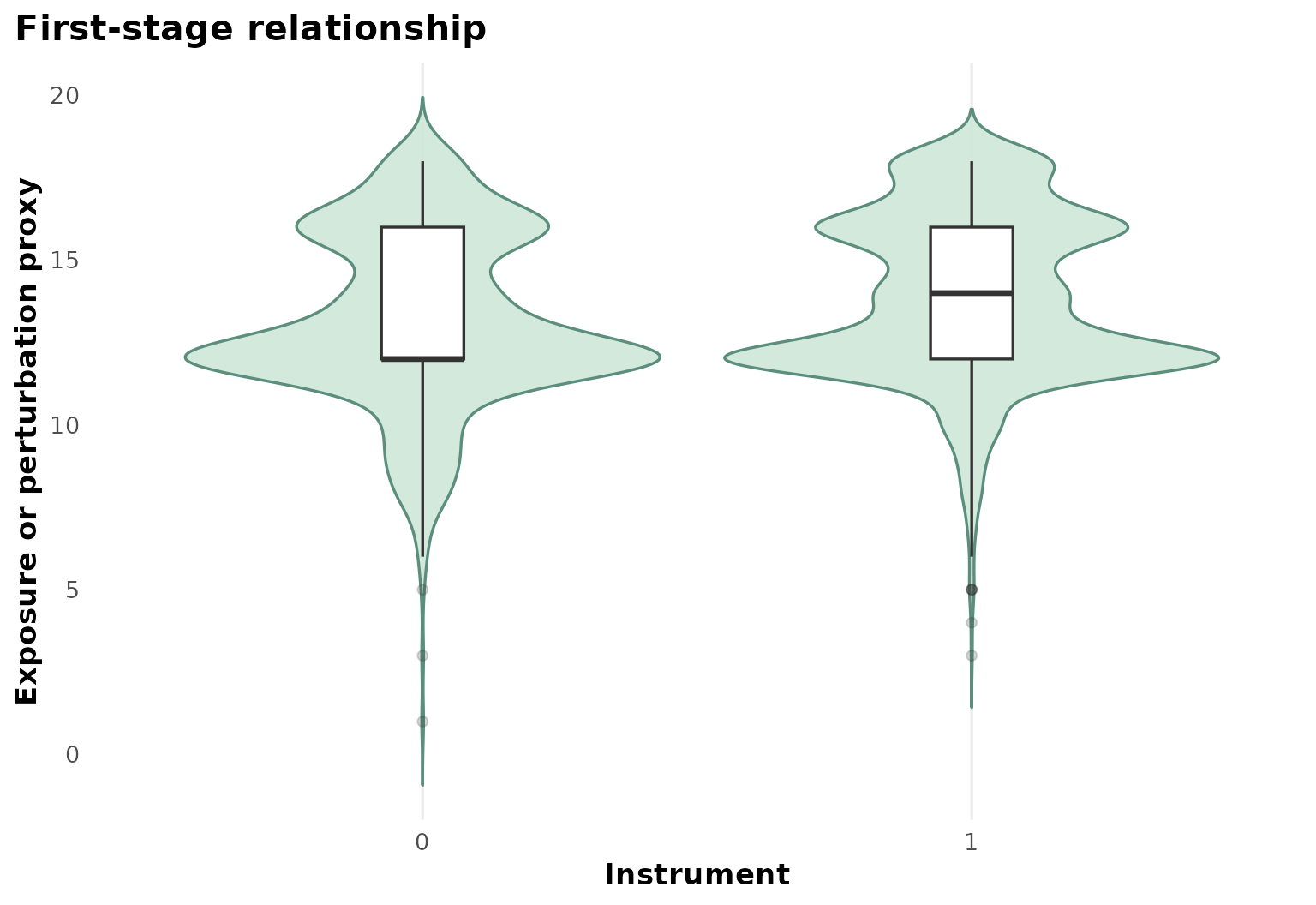
The first-stage figure shows whether the instrument visibly shifts
education. This is not a full relevance analysis, but it is a useful
visual complement to the first-stage F-statistic in
check_table.
Reduced form
plot_reduced_form(fit)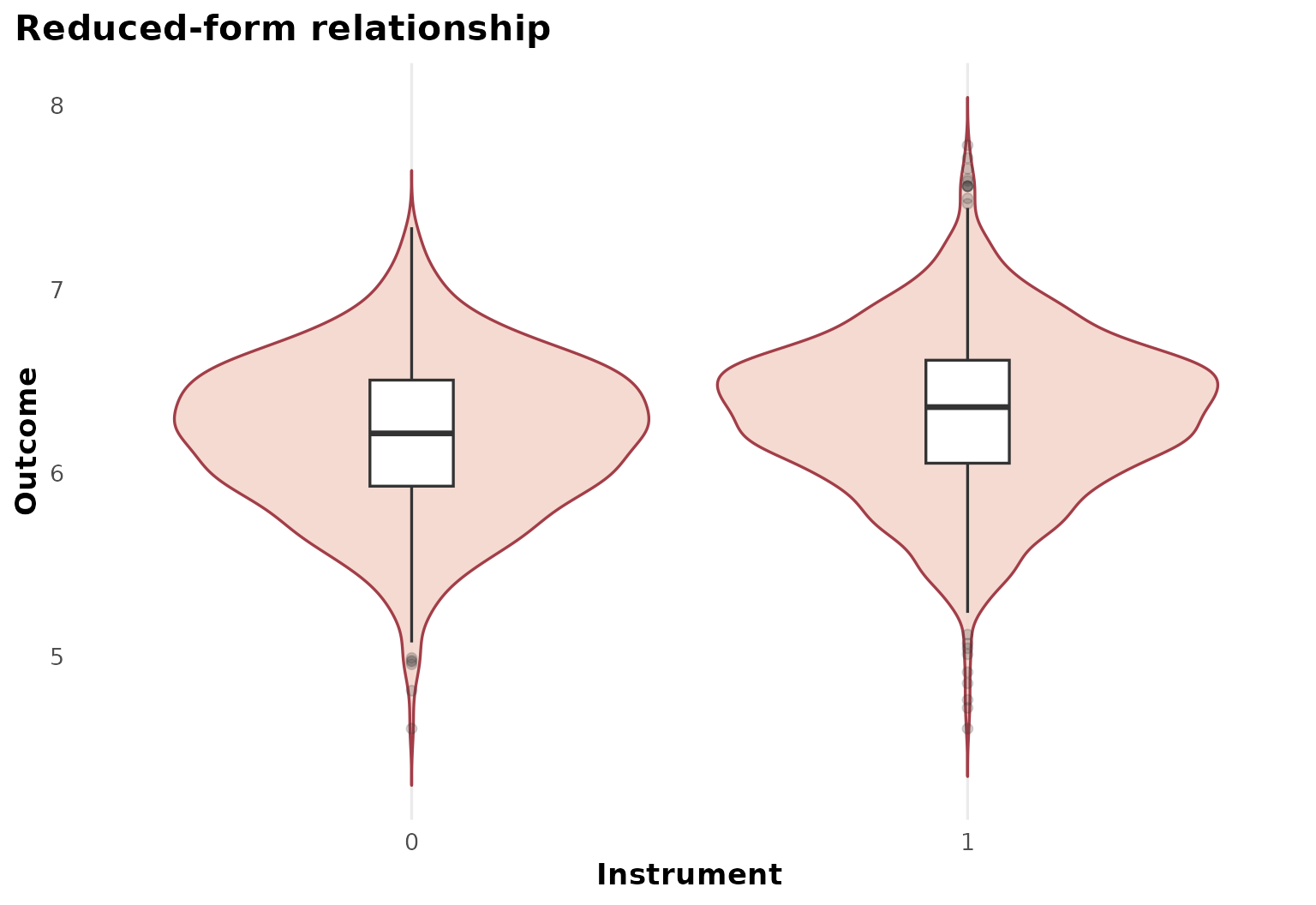
The reduced-form plot shows whether the instrument is also associated with the outcome. Together, the first-stage and reduced-form views help interpret the ratio estimand used by the instrumental forest.
Heterogeneous effect summary
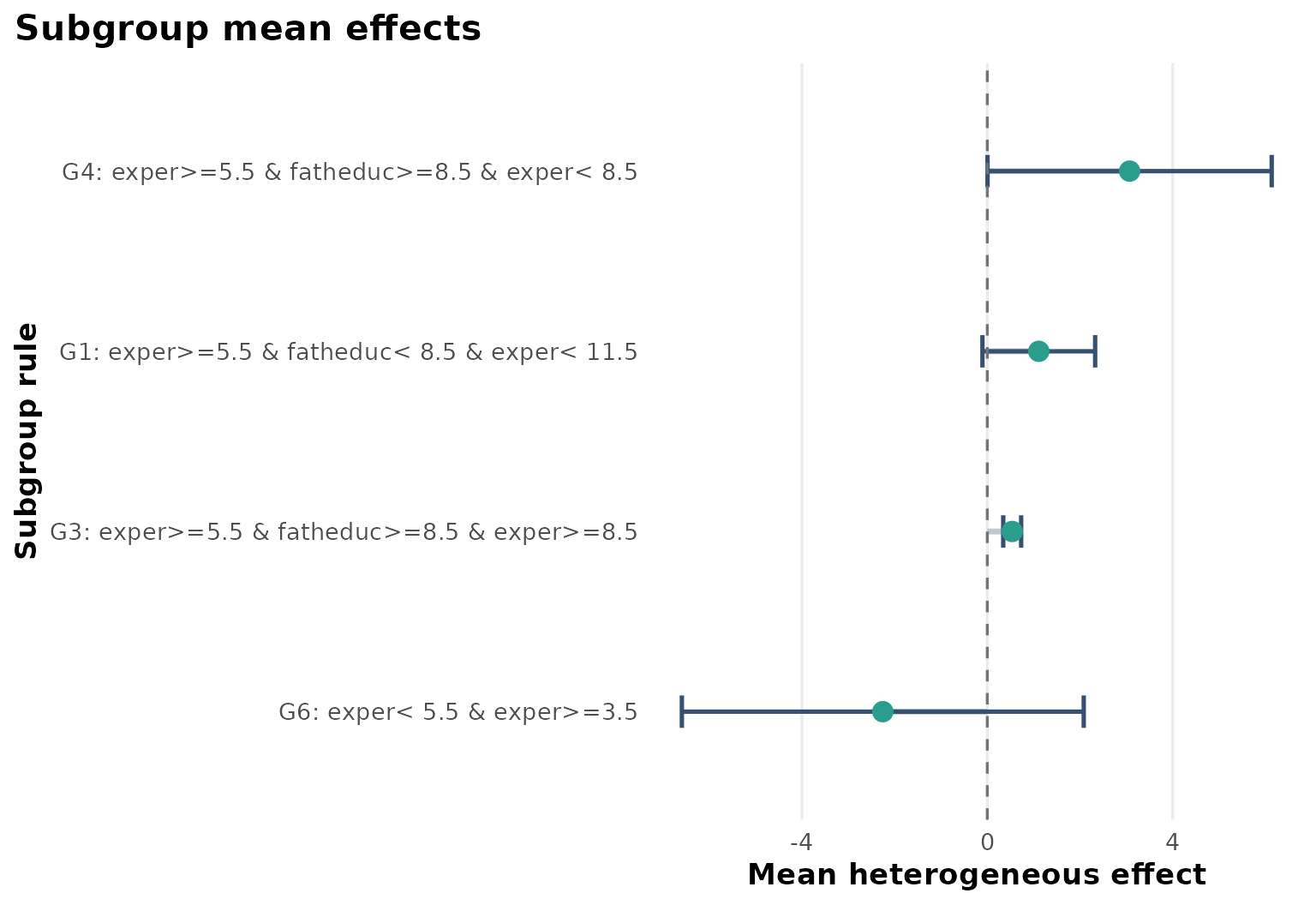
The subgroup plot shows that the local IV effect is not estimated as constant. In this example, parental education and labor-market experience help organize the heterogeneity.
Explanation tree
plot_effect_tree(fit)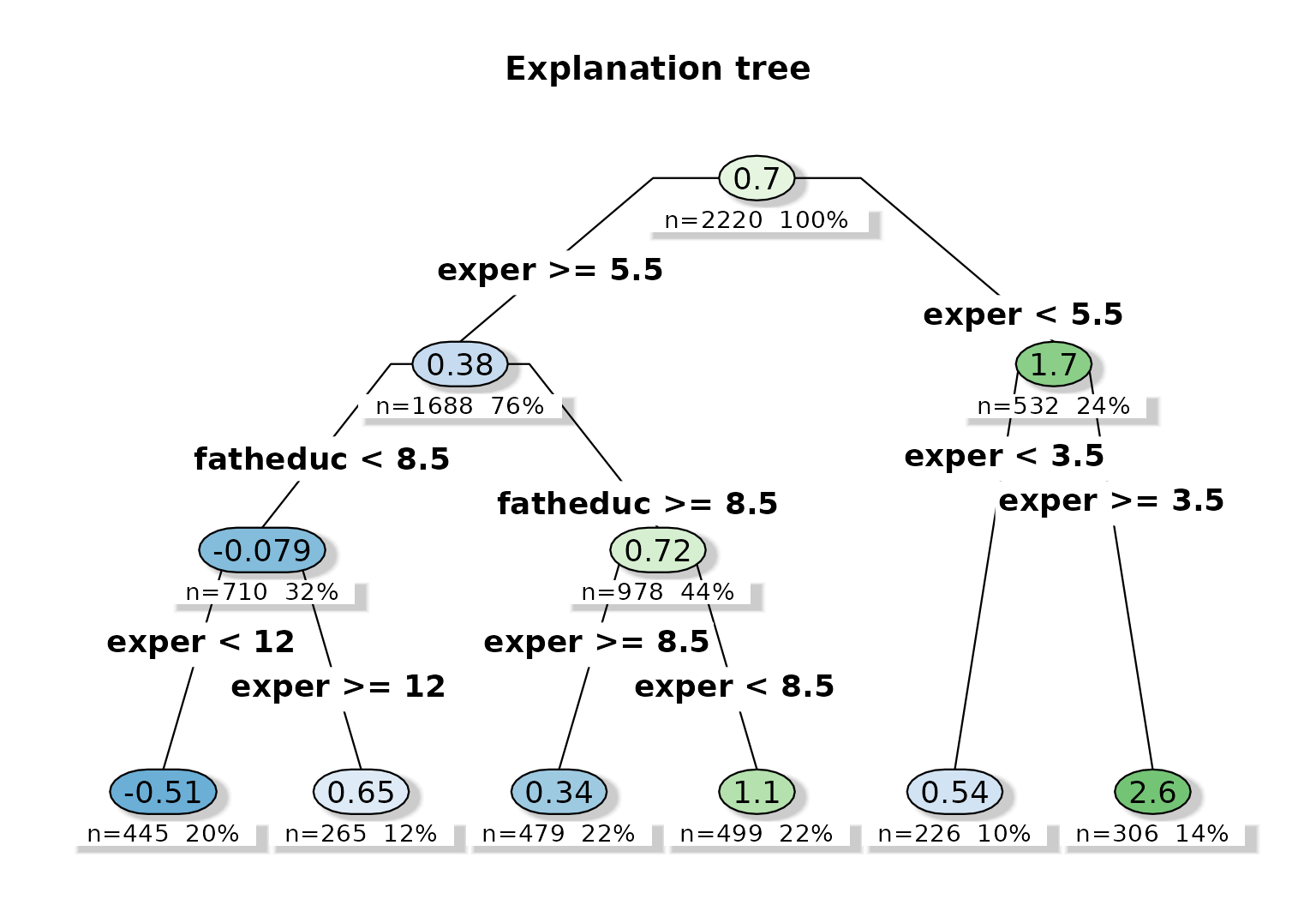
The explanation tree provides a readable summary of where the forest places its largest local-effect differences.
Variable importance
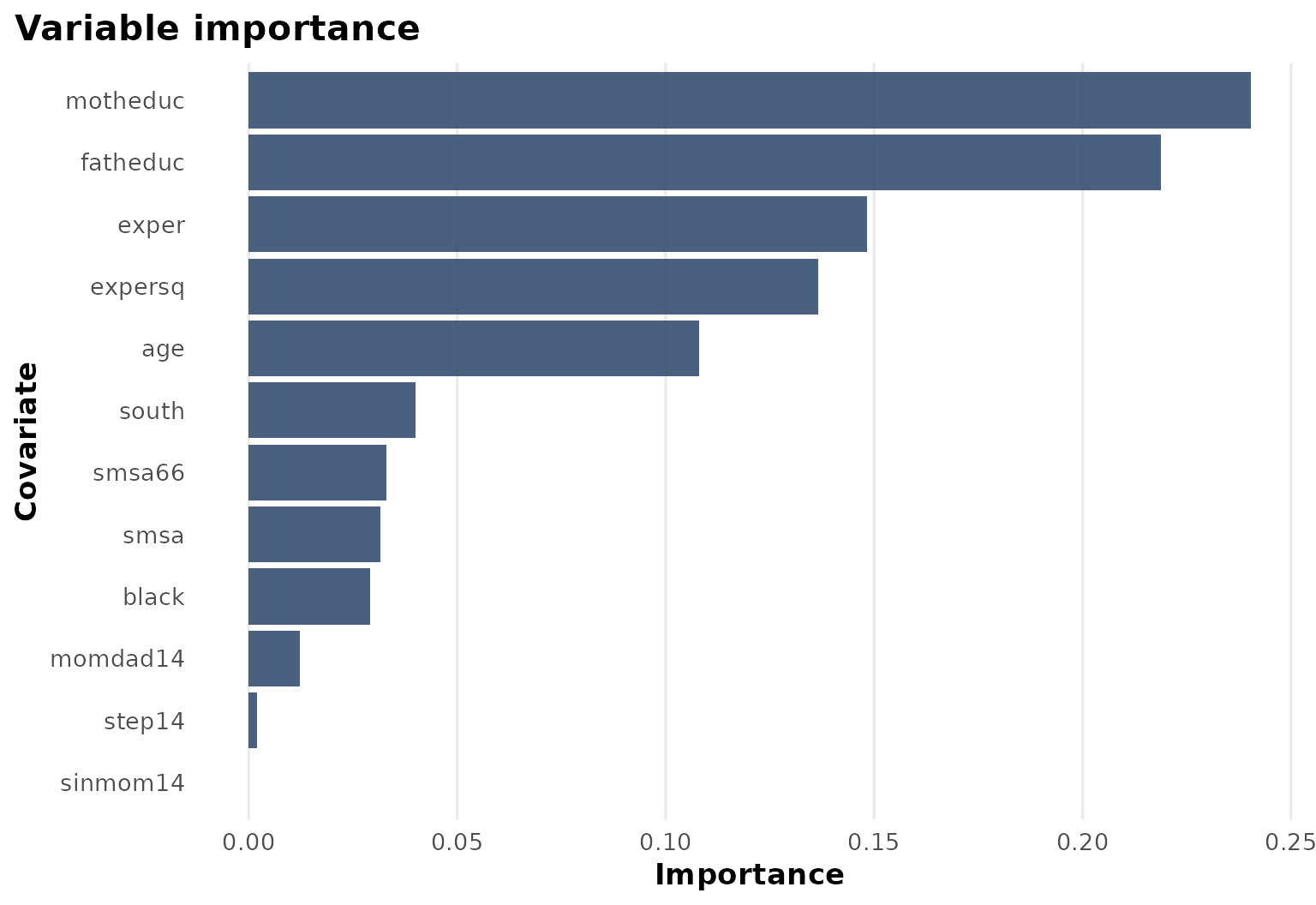
The top variables line up with an interpretable story: background advantage and experience shape where education returns appear most differentiated.
Interpretation
This case study is useful because it turns a standard IV tutorial into a heterogeneity tutorial:
- the first stage is visible,
- the reduced form is visible,
- subgroup differences can be summarized rather than left as one global IV coefficient.
Limitations
The package still reports weak-IV warnings for some leaves in this dataset. That means subgroup interpretation should be cautious. The local IV forest is most informative as a structured exploration of heterogeneous compliance-driven effects, not as automatic evidence that every leaf is equally well identified.