
Rare-state retrieval#
Background#
Rare or coherent disease states are the clearest current success case for TurboCell Atlas. They provide a compact neighborhood in embedding space, which makes candidate compression easier to trust.
Objective#
The goal of this scenario is to start from an IPF myofibroblast centroid and ask whether TurboQuant can preserve the biologically relevant nearest-neighbor structure while reducing candidate-layer memory.
Input#
The executed example uses the public SCimilarity tutorial dataset together with the real-data case-study pipeline included in the repository.
Process#
The workflow is:
define the centroid query
generate compressed candidates
rerank those candidates in the original embedding space
compare the final top-k result with exact retrieval
Result#
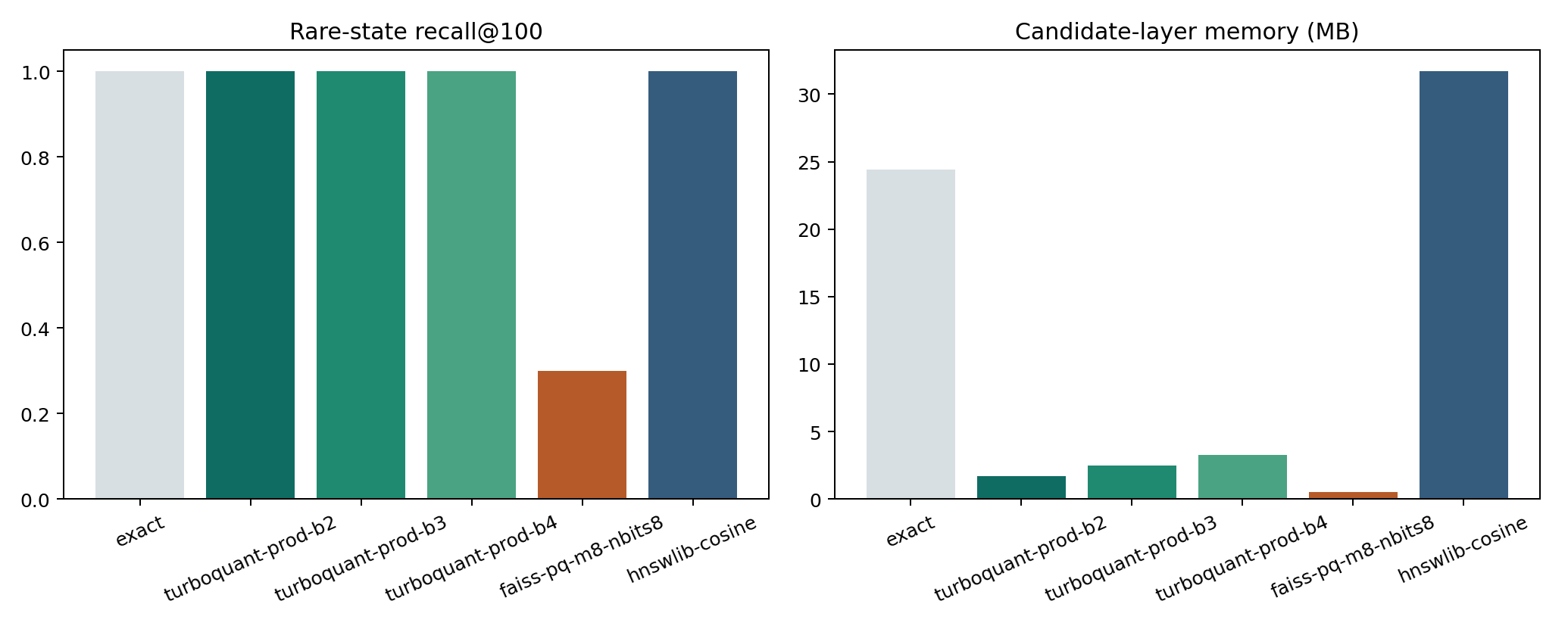
The rare-state article is valuable because it shows the strongest positive result in the current project state. In this scenario, TurboQuant preserved the exact top-100 neighborhood while using substantially less memory in the candidate layer.
What this teaches#
This tutorial shows that TurboCell Atlas is already useful for compact disease-state retrieval and for method comparison discussions where both memory and ranking agreement matter.
Related artifacts#
artifacts/scenario_articles/rare_state_summary.csv