litmap#

litmap is a Python package for reproducible literature mapping. It organizes one run as a canonical paper table, an analysis-space clustering workflow, a separate display-space projection, and a set of review-ready artifacts that remain understandable after the run is over.

The package is for workflows where a scatter plot is not enough on its own. You also want labels, summaries, diagnostics, coordinates, manifests, and a stable output layout that can be shared and revisited later.

Tutorials

Long-form case studies with cluster maps, PCA diagnostics, summary tables, and review-oriented interpretation. Open Tutorials

Getting started

Installation, CLI entry points, and the expected run layout. Open Getting started

API

The public Python surface that package users should rely on. Open API

Design

Architecture rationale, artifact boundaries, and the separation of analysis space and display space. Open Design

At a glance#

  • Run-oriented artifacts Each analysis leaves behind a canonical directory with files such as labels.csv, cluster_summary.csv, coords_2d.csv, and map_interactive.html.

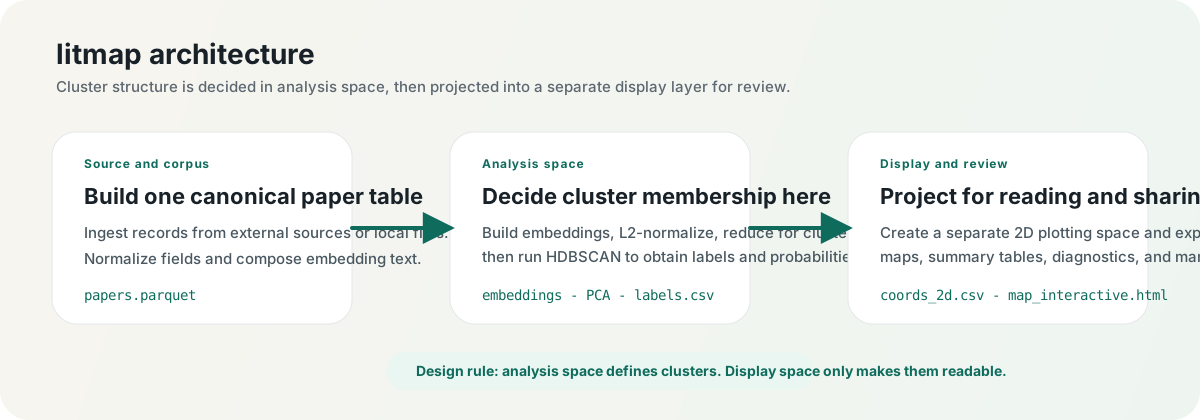
  • Two-space design Cluster membership is decided in analysis space. The 2D map is produced later in a separate display space.

  • Tutorial-first docs The package is documented through case-study articles, not only through short setup snippets.

  • Review-ready outputs The tutorials are written to support reading order, interpretation, and follow-up decisions.

Pipeline overview#

The shortest way to understand litmap is to see the separation between source and corpus, analysis space, and display and review outputs.

litmap pipeline overview

Simple architecture for one litmap run.#

Documentation map#

Current status#

Current status

Best current reading path: start with a tutorial article, then move to the design notes and API.

The package surface and documentation are ahead of the final computational backend. litmap should currently be understood as a strong package and documentation scaffold with deterministic tutorial pipelines while the full backend continues to mature.